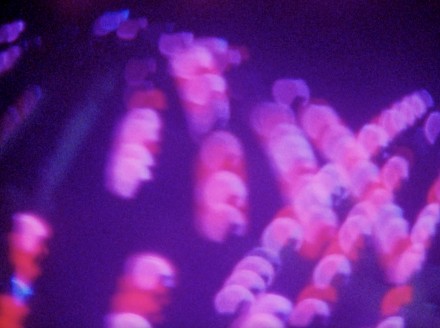
Lymelight
Available for sale: Digital file
Stills


About
A little Marie Menken, a little Ornette Coleman.
Shot on Super 8mm film in East Lyme, Connecticut, Lymelight is an attempt to reckon with the absence of nostalgia and reconcile my ambivalent feelings about fireworks on film versus fireworks in real life.
Artist Statement:
As a little kid, I hated fireworks. Everything about them — the noise, the sudden brightness, the unpredictability — terrified me. I even recall my parents giving me earplugs one summer while our family partook in Fourth of July festivities to stop me from crying. As I grew older, my political consciousness developed and the militaristic connotation of fireworks made me resent them even more. That, coupled with the terror and confusion they engender in many animals and the light pollution they cause still makes me wonder: how can someone enjoy something so assaultive?
Every year, during the last weekend of July in East Lyme, Connecticut (the town adjacent to the one I grew up in), all of Main Street is blocked off for “East Lyme Appreciation Day.” This celebration consists of a number of street vendors, live musicians, carnival rides, and fireworks. Despite my dislike of fireworks, East Lyme Appreciation Day was a highlight of many childhood summers. Having not attended one since moving to New York City, I decided to accompany a few friends in the summer of 2025 to see if I still felt a sense of nostalgia or magic. I didn’t — the experience proved strangely underwhelming — and I struggled with this unresolved feeling throughout the day while carrying around my Super8 camera. At sundown, I joined my friends on the boardwalk and decided to film the fireworks display in short, stochastic bursts.
The act of filming forced me to stare my fear directly in its face while simultaneously placing a barrier between myself and the fireworks; specifically, my attention to focus, framing, and the amount of footage I was using proved a kind of anesthetic. I subsequently sat on the footage for about a year, unsure of what to do with it. Then, I was reminded of two experimental shorts I had recently seen: one by Warren Sonbert (1991's Short Fuse), the other by Pablo Eguía (from the series Historia Natural, 2024-25). Both contained footage of fireworks and artificial light that was mesmerizing. I also recalled Marie Menken’s Lights (1966), one of my favorite experimental films, wherein the filmmaker abstracts a plethora of department store lights at Christmastime with her handheld 16mm camera. Naturally, Kenneth Anger’s Fireworks (1947) — which features stunning homoerotic footage of a Roman candle shooting sparks, among other visuals — was also top of mind. I realized that fireworks were the fodder of many avant-garde filmmakers for an obvious reason. They are the embodiment of cinema in its most elemental form: light and motion. (The act of a firework lighting off is also a microcosm of cinema's evolution: just as the first films were black-and-white and silent before the advent of color cinematography and eventually "talkies," a firework's initial burst of light and motion is followed by color, and finally, sound).
As with the films of Menken, Anger, Sonbert, Eguía, and countless others, could my filmic apparatus in some way counterbalance or defang something I so feared and reviled? Transmute violence and artificiality into a kind of lush hypnosis? I didn’t want to make the fireworks appear sensual or romantic, but might re-presenting and disrupting their frenetic intensity — coupled with the garish neon patterns of the carnival lights — metamorphose their havoc into something subversive and even sumptuous? Neutralization by way of abstraction? Trading bellicose aggression for psychedelic flamboyance, machine-gun staccato for the spontaneous, improvisational flow of free jazz?
Lymelight is my attempt to answer these questions, and to reconcile my ambivalent feelings about fireworks on film versus fireworks in real life. Released in the midst of America's semiquincentennial, the film is also my attempt to subvert, critique, and render incoherent a classic patriotic symbol at a time in our country's history when so many of its citizens (particularly immigrants, BIPOC, and members of the LGBTQIA+ community) are under attack from the federal government. On the one hand, Lymelight's inclusion of Ornette Coleman's "First Take" (which first appeared as an outtake on reissues of his landmark 1960 album Free Jazz: A Collective Improvisation) functions as an aural counterpart, even catalyst, to the visuals. The spontaneity and hyper-saturation of Jackson Pollock's Abstract Expressionist paintings was top of mind while I was editing this film; Pollock's "White Light" was used as the original cover artwork for Free Jazz. On the other hand, Coleman's composition reifies the political underpinnings of the piece. Free jazz as a genre — in all its freewheeling and convention-busting anarchism — was inevitably linked to the Black liberation and anti-war movements of the late '50s, '60s, and '70s (see "Free Jazz/Black Power" [1971] by Philippe Carles and Jean-Louis Comolli). Its liberating sound still bucks traditionalism (musical or otherwise) and continues to resonate with Leftist movements in our current sociopolitical context.
Films
-
Other films by this artist in our catalogue
- Read More
 ExperimentalNarrative
Business Casual
Matt McKinzieDigital, color and b/w, sound, 8 minRental format: Digital file - Read More
 Experimental
Queer Dream Triptych
Matt McKinziedigital, color, sound, 2.5 minRental format: Digital file - Read More
 DocumentaryExperimental
Introducing Belle Jolie!
Matt McKinzieSuper 8mm, color, sound, 2 min - Read More
 Experimental
Death Tape
Matt McKinzieSuper 8mm, color, sound, 3.5 minRental format: Digital file - Read More
 DocumentaryExperimental
A Very Fleshlumps Christmas
Matt McKinzieSuper 8mm, color, sound, 4.5 minRental format: Digital file - Read More
 DocumentaryExperimental
Embryonic Journey
Matt McKinzieSuper 8mm, color, sound, 5 minRental format: Digital file