
Her Gaze
Films
- Read More
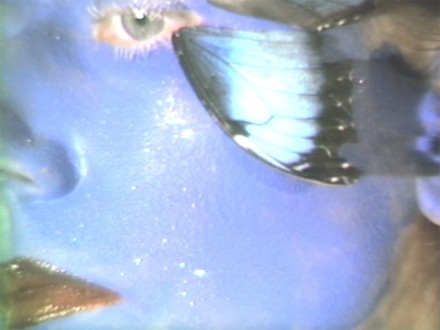 ExperimentalNarrativeInstallation
Blue Transcendence
Erica SchreinerDigital, color, sound, 8.25 minRental format: Digital file - Read More
 ExperimentalNarrative
Hoover
Marja SamsomSuper-8 digitized, black and white, silent, 2.29 min - Read More
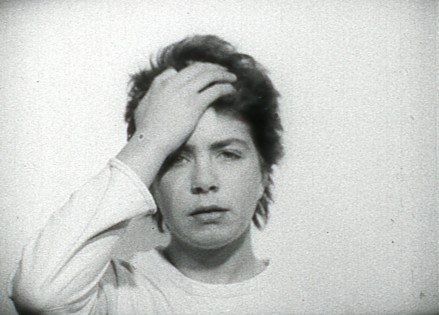
Who Do You Think You Are
Mary Filippo16mm, black and white, sound, 10 minRental format: 16mm - Read More
 Experimental
Meshes of the Afternoon
Maya Deren16mm, black and white, sound, 14 minRental formats: 16mm, Digital file
Description
On Saturday, December 6th, 2025, at 7pm, join us at The Film-Makers' Cooperative (475 Park Avenue South, 6th Floor) for HER GAZE: a program that brings together visionary women artists who perform for their own cameras, redefining the female gaze through self-directed acts of looking and being looked at. Curated by Matt McKinzie and Erica Schreiner.
Curated by Erica Schreiner and Matt McKinzie, Her Gaze brings together visionary women artists who perform for their own cameras, redefining the female gaze through self-directed acts of looking and being looked at. In the whimsical and perceptive How Much Does the Monkey Count, acclaimed multimedia artist Barbara Rosenthal turns a VHS camera on herself while playing the role of a ventriloquist. Accompanied by a puppet of a monkey, she offers “a simple performance about a complex issue: the contemporary psyche and its primitive roots.” In Leafmold, an essay film and experimental documentary by Benja Thompson, the filmmaker appears before the camera to present a work about gender decay that is “spun from chambered secrets and texts read under the full moon… explor[ing] contradictions of masculinity and the feminine threshold.” Filmed on a VHS camera in Erica Schreiner’s apartment, Blue Transcendence conveys “a montage of blue butterflies, a performance in blue, and time lapse of a candle burning during a magical spell. The narration guides the audience through a psychedelic experience, reflecting on real friendships and the importance of being silly.” Shot on Super 8mm, Hoover explores the relationship between gender, domesticity, and glamour, depicting filmmaker and multimedia artist Marja Samsom entangled with a vacuum cleaner; Samson characterizes the film as “classic restraint, glamorous resistance on housekeeping.” Mary Filippo writes, directs and acts in Who Do You Think You Are, shot on 16mm black-and-white film. In the piece, the main character, a filmmaker (played by Filippo), “investigates her own cigarette smoking habit while wishing she could make ‘a film about injustice.’ She wishes, in other words, to do something heroic. She has been seduced by the image of the cigarette-smoking hero, but an image is only an image.” Maya Deren’s Meshes of the Afternoon, one of the most influential works of American avant-garde cinema, presents a circular and dreamlike narrative in which a woman (played by Deren) encounters a flower, a mysterious hooded figure with a mirror for a face, a key, a bread knife, a telephone, and a phonograph, in an increasingly nightmarish sequence of events. The program concludes with Stephanie Leibowitz’s Don’t Feel Bad For Me. Shot in a confessional style, with digital timestamp quality, it is comprised of earnest, stream of consciousness thoughts. Developed over a decade, this diaristic series “encapsulates the universality of self skepticism, the anxiety of the unknown, the fear of complacency, and the desire to discover one’s identity while making other plans.”
Program:
-
Barbara Rosenthal, How Much Does the Monkey Count (1988, video-to-digital, color, sound, 4 minutes)
-
Benja Thompson, Leafmold (2024, digital, color, sound, 7.5 minutes)
-
Erica Schreiner, Blue Transcendence (2022, video-to-digital, color, sound, 8 minutes)
-
Marja Samsom, Hoover (1977, Super 8mm-to-digital, color, silent, 2.5 minutes)
-
Mary Filippo, Who Do You Think You Are (1986, 16mm-to-digital, black-and-white, sound, 10 minutes)
-
Maya Deren, Meshes of the Afternoon (1943, 16mm-to-digital, black-and-white, sound, 14 minutes)
-
Stephanie Leibowitz, Don’t Feel Bad for Me (2025, digital, color, sound, 11 minutes)
Total Run Time: 57 minutes + discussion and Q&A with the filmmakers.