Screening
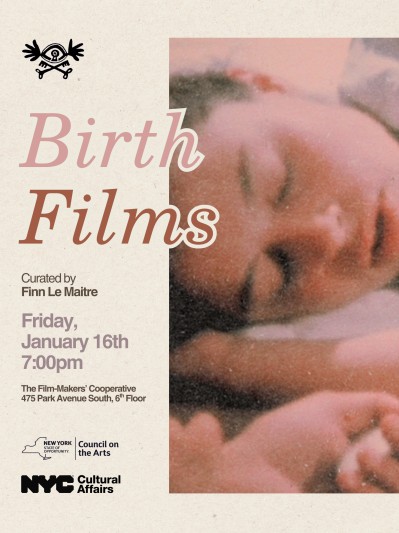
On Friday, January 16th, at 7pm, join us at The Film-Makers' Cooperative (475 Park Avenue South, 6th Floor) for our first screening of the year: a program of films from the Coop's collection about childbirth, curated by Finn Le Maitre.
Childbirth has long been a defining preoccupation of American avant-garde filmmakers. The genre is usually said to begin with Window Water Baby Moving (1959), Stan Brakhage’s lyrical portrait of Jane Brakhage (née Wodening) giving birth to their daughter, Myrenna. But there were precedents at the outer edges of avant-garde film. In New York, the influential film society Cinema 16 often programmed medical birth documentaries alongside experimental works. These proto-birth films included Childbirth: Normal Delivery, A Normal Birth, Margaret Mead: First Days in the Life of a New Guinea Baby, All My Babies, Hypnosis in Childbirth, and Intra-Uterine Movements of a Foetus. Cinema 16’s deliberately transgressive programs positioned childbirth in opposition to the moral hygiene of mainstream cinema. From the beginning, avant-garde birth films similarly combined attention to birth with a self-conscious interest in the ethics of showing birth on film. Window Water Baby Moving, for instance, seems to anticipate the scandalized response of its viewers. Brakhage frames Jane’s body to fashion a series of metaphors for the breakdown of the boundary dividing private and public visual space.
Maya Deren was among the first to question this strategy from a woman’s point of view. She reportedly criticized the film at its premiere, remarking that “Even the animals, when they give birth, retreat into a secret place.” (Deren herself had collaborated on an animal birth film, The Private Life of a Cat, with her first husband, Alexander Hammid). Even as it provoked controversy, the film was screened widely and exercised enormous influence. Some, though of course not all, audience members responded by making their own birth films. Through the work of filmmakers who variously emulated, revised, and critiqued their precursor(s), the theme came to constitute a genre—a key bridge between the Romantic “visionary” and feminist traditions.
This program includes a selection of important but infrequently screened birth films from the FMC collection. It begins with the first birth, Adam’s Birth by Freude Bartlett. This is followed by Blue White, a rarely seen Brakhage birth film. Janis Crystal Lipzin’s Other Reckless Things responds to news of a woman who performed her own Caesarean section. Takahiko Iimura’s Onan explores the analogy between female procreative labor and (conventionally) male acts of artistic creation. The program ends with Marjorie Keller’s landmark experimental documentary, Misconception, a film about the everyday marital negotiations surrounding birth.
Program:
- Freude Bartlett, Adam’s Birth (1973) 1 minute
- Stan Brakhage, 3 Films: Blue White/Bloodstone/Vein (1965) 8 minutes
- Janis Crystal Lipzin, Other Reckless Things (1984) 17.5 minutes
- Takahiko Iimura, Onan (1963) 7 minutes
- Marjorie Keller, Misconception (1977) 43 minutes
Total Run Time: 76.5 minutes.